- Brazil Beachfront
- Posts
- How Savvy Investors Validate Their Convictions
How Savvy Investors Validate Their Convictions
Why smart money insists on confirmation before action... and where they go to get it

Mikkel Thorup
January 22, 2026
Hey guys, Mikkel here,
Over the past few months, my energy has been pulled in one very specific direction…
Behind the scenes, nearly everything my team and I have been doing has revolved around one focal point: preparing for The Wealth, Freedom & Passports Conference in Panama this coming March.
The world is shifting.
Trade blocks are being redrawn.
Capital is flowing toward countries that can actually produce food, energy, and real goods.
Governments are competing for people, investment, and relevance.
…and while most people are still reacting to headlines one at a time, the real story is being written at the intersection of trade, geography, mobility, and real assets.
That’s why I’ve been so consumed with bringing together the right partners and opportunities for this 2nd annual Wealth, Freedom & Passports Conference.
The best way to connect those dots with real clarity is to get in a room with the people who are actually moving capital, structuring residencies, building projects, and deploying capital in regions that are going to thrive long term.
That is exactly what The Wealth, Freedom & Passports Conference is designed to do.
It’s not about listening to speakers and going home with a notebook full of information that will do nothing more than overwhelm you…
It’s about seeing how mobility, offshore structures, international real estate, and macro trends fit together into a single, actionable Plan-B.
When the global order is shifting, the worst place to be is standing still with a purely domestic strategy, hoping nothing changes fast enough to force your hand.
This March in Panama is where the abstract elements of offshore living and investing become crystal clear.
It’s where partners, projects, and people stop being names on a screen and become real.
…and it’s where many of the most important conversations of the year will happen.
This is why I’ve been so busy.
…and this is why, if you’re serious about positioning yourself and your family for what’s coming next, you need to be there live in the room with me, my partners, my staff and hundreds of members from the Expat Money community this March from the 6th through the 7th.
If you want to get serious (or even more serious), you need to be able to sit in a room with people who are thinking at a higher altitude, who are making decisions based on where the world is going rather than where it’s been, and who are willing to act on that understanding.
That’s what the conference this March represents.
It’s a chance to step out of isolation and into a community.
It’s a chance to compare notes with others who share your concerns and are taking steps to ensure that themselves, their families, and everything they’ve worked so hard to build remain protected.
It’s a chance to focus deeply on what really matters when you’re trying to protect your family, your wealth, and your future in a world that’s becoming less predictable by the day.
Let’s get into it,
IF Brazil Gets Plugged Into a $22 Trillion Market, Expect MASSIVE Change
As the dominant member of Mercosur (the trade bloc that is comprised of Brazil, Argentina, Paraguay, Uruguay and Bolivia), Brazil accounts for over 70% of the bloc’s total GDP.
That alone already makes it the economic engine of South America.
…but now something far bigger is in the works…
Mercosur is working to finalize a historic trade agreement with the European Union, and if it becomes a reality, it would become the largest free-trade zone in the world.
This new trade agreement (if approved) would:
Eliminate 91% of import taxes between the two regions
Represent over $22 trillion in combined GDP (larger than China)
Serve 720 million consumers
Control the largest food-production supply chain on Earth
If passed, it would mark a structural shift in how capital, goods, and production will move.
…and Brazil would be sitting in the middle of it all.
For anyone who mistakenly held views that Brazil was some small-time regional player that only thrived due to servicing the needs of its domestic population, even the fact that this is being tabled as a possibility should have you reconsidering everything you thought you knew (to be clear, this deal is far beyond the point of simply being “discussed”).
Trade agreements don’t just reduce taxes.
They re-route capital flows.
When tariffs disappear, companies stop asking “can we?” and start asking “how fast we can get this going?”
European firms suddenly gain direct, friction-free access to South American production.
Brazilian producers gain direct access to European buyers.
Logistics chains reorganize.
Supply contracts get rewritten.
Warehouses, ports, trucking routes, and industrial hubs expand.
…and when that happens, one thing always follows:
People move.
Money moves (including institutional capital).
Consumer confidence increases.
…and real estate values rise, quality of life standards increase, and in time, the middle class grows even stronger.
Brazil’s natural advantages in food, energy, and labour are vast, and now with a whole new region accessible, when these new flows begin, money doesn’t trickle… it surges, pulling workers, infrastructure, and real estate demand along with it.
Although the Mercosur Alliance is comprised of five countries, economically, the big player in the trade bloc is Brazil, which means that when Europe commits to Mercosur, what it is really doing is committing to Brazil as a long-term supply partner.
…and that is why economists are already projecting that this single trade deal would add another one percent to Brazil’s GDP growth over the coming years.
1%…
Yes, I get it - this figure that might sound small on paper but in an economy of Brazil’s size, this 1% represents an enormous force that would translate into higher wages, greater domestic consumption, and a stronger base for real asset appreciation across the country.
1% growth is ENORMOUS when you’re speaking about it in relative terms to the entire GDP of a powerhouse nation.
Simply put, in a country of Brazil’s size (and output), an increase of 1% GDP growth is transformational.
When trade agreements of this magnitude take effect, the impact doesn’t show up first in headlines or stock tickers - it shows up where capital and people actually collide.
It shows up in the form of new factories being built, ports expanding, trucking routes multiplying, warehouses filling, and entire logistics networks being upgraded to handle the flow of goods that now suddenly make economic sense.
As that production ramps up, wages rise, skilled workers migrate toward opportunity, families follow those jobs, and housing demand begins to surge in the places where this new economic activity takes root, because whenever you plug a country like Brazil into a $22 trillion free-trade engine, you don’t just move products - you move people, incomes, and long-term residential demand.
This is exactly how domestic demand and international trade collide to create durable real estate appreciation.
Once a country becomes structurally embedded in a massive global trade network (exporting food, commodities, and manufactured goods to Europe under tariff-free rules), big-time capital stops treating it as a developing market and starts treating it as an essential partner.
Banks will start to lend more freely, developers scale up their projects, infrastructure funding becomes easier to secure, and the entire financial system begins pricing in permanence rather than risk, and when that happens, real estate doesn’t just drift higher…
…it establishes a new baseline; a new price floor that reflects the country’s new role in the global economy.
…and the investors who arrive before that floor fully forms experience the biggest upside.
Trade growth, as we are already seeing and may see even more so soon, doesn’t just benefit the largest cities and industrial hubs, like São Paulo or Rio.
It pushes capital outward toward the entire country.
As production increases and wages rise, Brazilians seek out:
better places to live
better schools
better quality of life
better housing
That’s why regions like Brazil’s Northeast, with growing infrastructure, rising incomes, and still-reasonably priced property, would be among the beneficiaries.
When trade, food production, logistics, and manufacturing get locked into a long-term international supply chain, one thing becomes very clear to anyone paying attention…
The country isn’t “developing”…
It’s a strategic partner on the verge of ingraining itself within the most important trade networks.
Once a country is integrated into a $22 trillion trading bloc, institutional capital begins to move decisively, and major changes unfold.
Developers scale up.
Infrastructure accelerates.
…and real estate finds a new baseline.
This trade deal (if passed) will help set a price floor for Brazil as a whole.
Construction Update: Porto Residence Is Taking Shape (On Schedule)
Porto Residence in Porto das Dunas is moving forward exactly as planned, and I want to give you a clear snapshot of where things stand on the ground right now.
We’re fully on schedule to deliver this project in June of this year (2026).
This is the part of a project where progress becomes visible not just to engineers but also to owners.
On the northwest façade, the ground-floor plaster base coat is now 80% complete, which means the surface preparation for finishing work is well underway.
At the same time, formwork removal from the roof slab beams has reached 60%, and shoring removal on the second floor is already at 70%.
These are clear signs that the structural phases are wrapping up and the building is transitioning toward its next stage.
Inside the building, the subfloor installation on the first floor (Stage 1) is now 55% complete, which is the foundation for everything that comes next - flooring, finishes, and final fit-out.
Up top, the perimeter masonry on the rooftop has already reached 80% completion, further locking in the final footprint and confirming the architectural form of the building.
Across the site, post-concreting cleanup is now 60% complete, and plastering on the northeast façade is also sitting at 60%, which means Porto Residence is firmly moving out of the raw concrete phase and into the stage where it begins to take on its finished look and feel.
This is one of those moments in every development where things stop looking like a construction site and start feeling like a real place - a place where tenants will live, where rental income will be generated, and where owners will soon be holding keys.
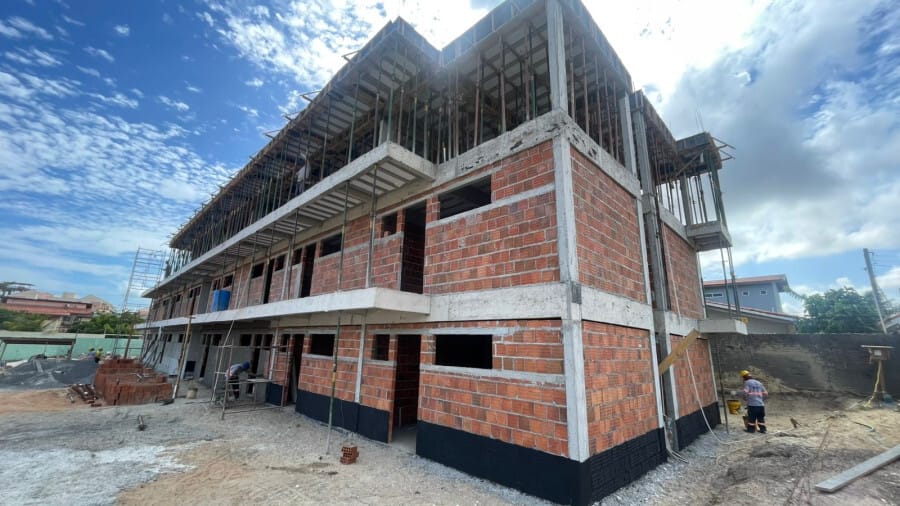
If you can picture past the scaffolding and exposed surfaces, you can already start to see what Porto Residence is becoming: a modern, purpose-built residential building in one of Brazil’s fastest-growing coastal communities, designed to earn consistent rental revenue through a short-term stay model.
The heavy lifting (and the most technically complex, time-consuming, and risk-sensitive part of the build) is now behind us.
From here forward, the work becomes even more visible, tangible, and exciting as finishes, facades, and final details bring the project fully to life.
I’ll continue to keep you posted as Porto Residence moves closer to delivery, but for now, I’m pleased to confirm that everything is tracking exactly as it should.
To those of you who secured a unit here, congratulations, and in just 5 or so months, you will have keys in your hand (physically or metaphorically) and will be able to enter your unit into the rental market, where you can expect turn-key, hands-off revenue for decades to come.
The Global Order Is Shifting… and this is what it looks like on the ground
To anyone paying attention, it is clear that the world is moving away from a single-centred system dominated by a handful of Western economies and toward a more decentralized structure in which production, food, energy, and capital are distributed across countries that can actually deliver what the world needs.
This is exactly why places like Brazil are no longer being treated as “emerging markets,” but as essential pillars in a new economic order that prioritizes resilience, supply security, and real assets over financial engineering and political promises.
Europe isn’t interested in signing agreements with Mercosur because it wants to be more inclusive…
…they want to do it because they need reliable access to food, raw materials, and productive capacity in a world where supply chains have proven fragile, energy markets have become volatile, and geopolitical risk has made over-reliance on any single region a major liability.
This is why you’re seeing investment flows, manufacturing plans, and logistics networks realign toward South America, because when the global system starts looking for durable partners, it chases countries that can actually grow food and ship goods.
DEAL OF THE WEEK: Turning One Smart Decision Into an Offshore Income Engine (sub 185k)
Most people with capital to deploy don’t actually lack opportunity.
They lack structure.
They end up wiring six figures into whatever property happens to be in front of them (usually in a market that is already overbuilt, over-regulated, and overpriced) and then spend the next decade hoping that appreciation and rent increases will someday justify the decision they made out of convenience.
That is not how wealth is built.
Real portfolios are deliberately designed, thoughtfully layered, and positioned within economic currents that are already moving.
That’s exactly what this new Beach Park Bundle that I am going to tell you more about shortly represents.
Porto das Dunas is transitioning from a coastal getaway into a self-sustaining hub and soon-to-be globally recognized community.
…just like we’ve been predicting (and placing calculated, evidence-based bets on long before the others even started catching on).
There are moments when a market crosses the line from potential to proven, and in the case of Porto das Dunas, it means no longer just being known for its stunning beaches or for being home to South America’s largest waterpark.
At this point, by all accounts, Porto das Dunas is well on its way to becoming a self-sufficient micro-city where tourism, retail, residential, and long-term rental demand are all rising in lockstep.
…and still, despite this, as unbelievable as it is, the prices sit years behind where they should be.
Now… back to the Beach Park Bundle…
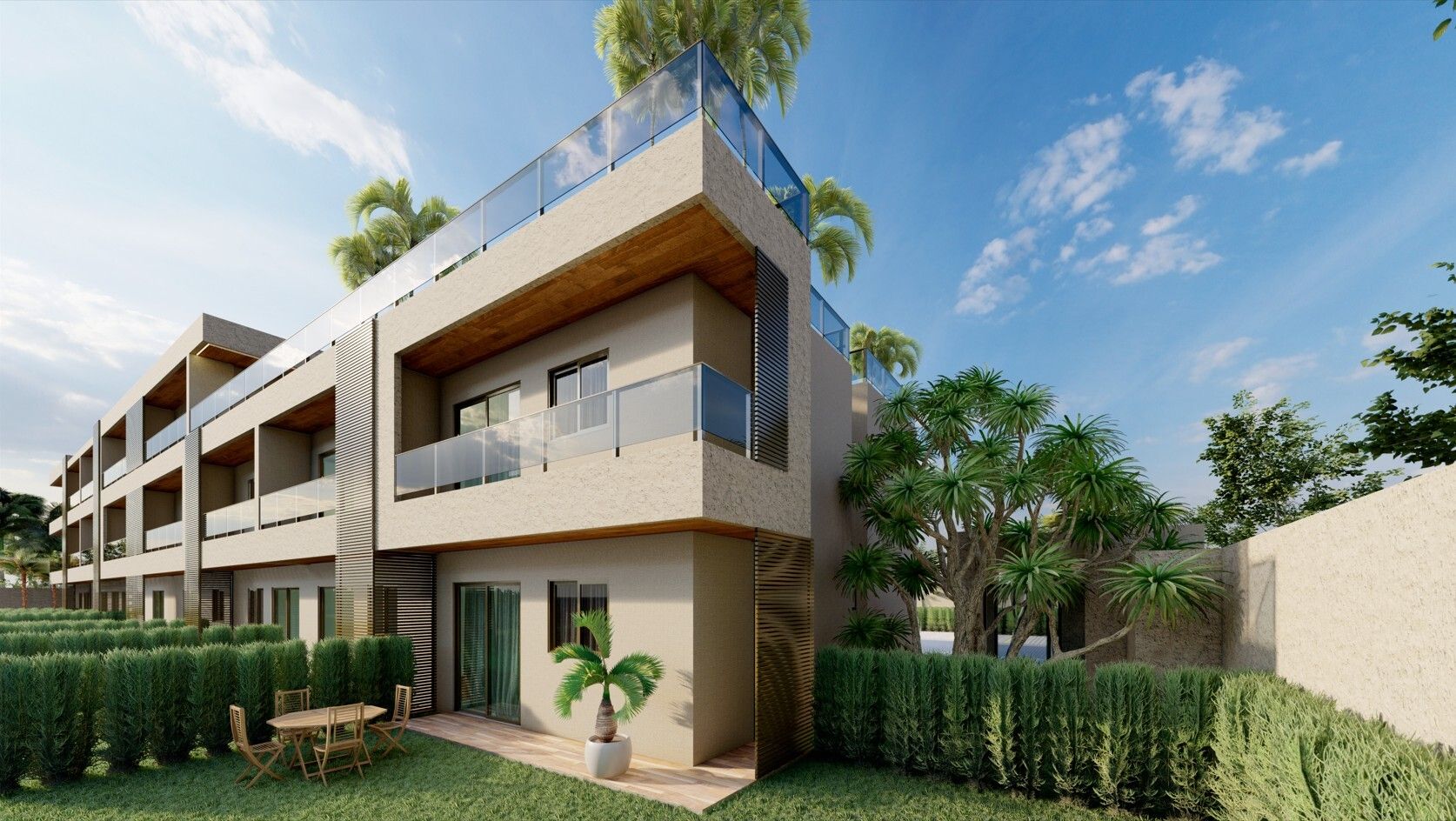
Instead of scattering capital across random assets, this bundle strategy gives you two fully furnished, professionally managed short-term rental units inside one of the most powerful domestic tourism corridors in Brazil.
It’s a location that captures year-round demand from middle-class families, professionals and weekend travellers who don’t need international flights or to keep coming back, which matters a ton to investors like us because the strongest rental markets are not built on the backs of “trending destinations”…
They’re built on top of consistent domestic demand that never turns off.
Look at some of the biggest tourism markets in the world, and you’ll notice they are fuelled by domestic tourism.
“Hotspots” come and go in cycles, but when a region is fuelled by its domestic population, the cycle is never-ending and most often experiences only downswings in line with the domestic economy (which right now is booming).
Brazil’s domestic tourism engine is one of the largest and most resilient in all of Latin America, and Beach Park (one of the world’s top 5 most visited waterparks) sits directly in its path, meaning your units are not waiting around for foreign visitors or seasonal spikes to survive.
They are being fed by millions of Brazilians who travel constantly within their own country.
Short stays.
High occupancy.
High turnover.
Consistent cash flow.
That’s the kind of demand profile that builds your wealth while you sleep… without you having to lift a finger to earn it.
These units will be ready in about 5 months and delivered fully furnished, already set up and positioned to produce income from day one.
You don’t coordinate anything.
You don’t manage anything.
You don’t have to spend time thinking about how to increase your yield.
You don’t have to worry about dealing with the demands of your guests.
You don’t have to concern yourself with a single thing other than tracking your incoming monthly cheques.
YOU own.
THEY operate.
YOU collect.
The all-inclusive price for this special bundle won’t run you half a million dollars (although 10 years from now, it very well could).
This bundle is priced at $183,000 USD.
In practical terms, means you are acquiring two income-producing assets in a growing coastal market for less than what most North Americans now need just to outlay for a downpayment on a townhouse in a 2nd-tier city.
This is offshore income, in your name, inside a jurisdiction where growth is real, and demand is rising based on hard macro-economic factors.
…and if you’re not in a position to deploy all the capital at once, flexible payment options are available.
Just write Michael at [email protected], and he’ll walk you through what that looks like.
Most people don’t even know that capturing such high-growth opportunities is available to them.
You do.
Even by your reading this newsletter, you now know this.
Now… the question is: will you act on what you know before the world catches on?
To secure one of the few available Beach Park Bundles, email Michael directly at: [email protected]
Tell him you’re interested in the two-unit Beach Park Bundle, and he’ll take it from there.
If you’ve been reading about the hard-won opportunities I share with you and know that hearing about the “whys” & “hows” directly from the horse’s mouth is incredibly valuable, you’ll be able to speak with Michael directly next month at The Wealth, Freedom & Passports Conference in Panama next month.
Some of you will come to Panama as a way to dip your feet into this world.
Some of you will come to take a serious look at what life and/or investing outside your home country could look like for you and your loved ones.
…and some of you will come ready to start putting pieces in place.
What matters most is that you give yourself the chance to be in the environment where these conversations happen naturally, where you’re surrounded by other people who are thinking about their families, their capital, and their future in the same serious way you are.